Understanding the Differences Between Wired and Wireless CarPlay Solutions
“Just go wireless” gets thrown around as an obvious upgrade, and for most drivers it is one. But wired and wireless CarPlay aren’t simply the same experience minus a cable — there are real technical trade-offs behind that missing cord, and understanding them helps you set the right expectations, whichever you end up choosing.
🔌 How Each One Actually Works
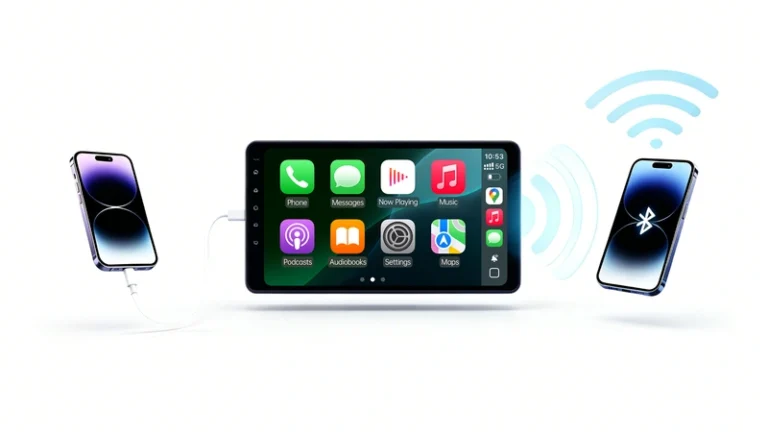
Wired CarPlay sends video, audio, and control data over a physical USB (or Lightning) cable connected directly between your phone and the head unit. It’s a direct digital connection with minimal signal processing in between.
Wireless CarPlay replicates that same data exchange over Bluetooth (for the initial handshake) and 5GHz Wi-Fi (for the actual video/audio stream), meaning your phone and head unit are constantly communicating over radio signals instead of a cable.
That difference in transmission method is the root of every trade-off below.
⚡ Latency
Wired: Essentially instantaneous. Touch input, screen refresh, and audio playback all happen with negligible delay, since data doesn’t need to be compressed and transmitted wirelessly.
Wireless: Modern wireless CarPlay has closed most of this gap, but a small amount of latency is still inherent to the format — Wi-Fi transmission involves some encoding/decoding overhead that a direct cable simply doesn’t have. In day-to-day use this is rarely noticeable, but it can show up as a very slight delay when scrubbing through a podcast or tapping rapidly through menus.
Verdict: Wired wins on paper, but the real-world gap is small enough that most drivers never notice it with a properly implemented wireless system.
🔊 Audio Quality
Wired: Audio travels as uncompressed digital data over the cable, then gets processed by your car’s own amplifier and speakers — the audio quality ceiling is set entirely by your car’s sound system, not the connection.
Wireless: With a proper integration module (rather than a basic Bluetooth-only adapter), audio quality can be just as good, since the module decodes and routes the signal through your original amplifier the same way a wired connection would. The catch is that not all wireless implementations are equal — a cheap adapter relying purely on Bluetooth’s A2DP audio profile does introduce some compression, which a well-engineered integration kit avoids by handling audio through a dedicated channel.
Verdict: Tied for wired vs. a quality integration kit; wired wins clearly over a basic Bluetooth-only wireless adapter.
🔄 Reliability & Connection Stability
Wired: A physical cable either works or it doesn’t — there’s no pairing process, no radio interference, and no risk of your phone prioritizing a different Wi-Fi network. The trade-off is mechanical: cables fray, ports wear out, and a connection can drop if the cable shifts while driving.
Wireless: No cable to wear out or come loose, but you’re now dependent on a clean Bluetooth handshake and stable Wi-Fi connection every time you start the car — which introduces its own occasional quirks, like the pairing conflicts we’ve covered in earlier posts on connection troubleshooting.
Verdict: Roughly a wash — wired trades mechanical wear for reliability, wireless trades wear for a small amount of connection variability.
💵 Cost
Wired: Often free or near-free if your car already has built-in wired CarPlay support — you just need a compatible cable.
Wireless: Requires either a wireless adapter dongle (if your car already has wired CarPlay) or a full integration kit (if it doesn’t have CarPlay support at all), adding a real cost on top of what a cable would run.
Verdict: Wired wins on cost, assuming your car already supports it natively.
🧳 Convenience
Wired: Requires physically plugging in every time, remembering to bring the right cable, and dealing with cable wear over months of daily use.
Wireless: Get in, and it connects automatically — no cable to find, plug in, or replace. This is the trade-off most drivers are actually buying when they choose wireless: less friction, every single drive.
Verdict: Wireless, clearly and consistently.
✅ Quick Comparison
| Wired CarPlay | Wireless CarPlay | |
|---|---|---|
| Latency | Negligible | Very slightly higher (rarely noticeable) |
| Audio quality | Set by your car’s sound system | Equal, if using a quality integration kit |
| Reliability | No pairing, but cable wear over time | No cable wear, but depends on clean pairing |
| Cost | Free if natively supported | Adapter or integration kit cost |
| Daily convenience | Plug in every time | Automatic on engine start |
So Which Should You Actually Choose?
If your car already has built-in wired CarPlay and you genuinely don’t mind plugging in, there’s nothing wrong with sticking to wired — it’s reliable, cheap, and technically has the lowest latency ceiling.
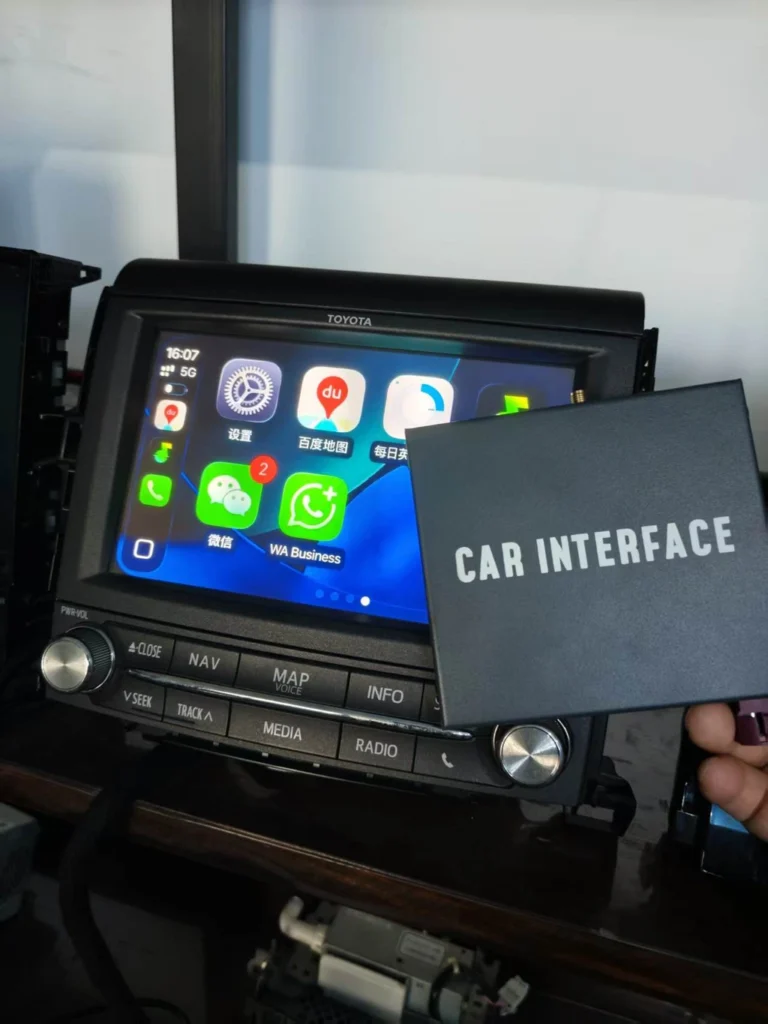
But for most drivers, the calculus comes down to this: the latency gap is barely perceptible in real-world use, audio quality can be fully preserved with the right hardware, and the daily convenience of never touching a cable again is a genuine quality-of-life upgrade. That’s especially true for older Toyota and Lexus models that never had wired CarPlay support to begin with — for those cars, the comparison isn’t really “wired vs. wireless,” it’s “no CarPlay at all vs. wireless CarPlay,” which makes the decision considerably simpler.
Getting Wireless CarPlay Done Right
The gap between “wireless CarPlay is great” and “wireless CarPlay is laggy and unreliable” almost always comes down to the quality of the hardware behind it. AUVETO’s Smart Integration Kits are built specifically to close that gap — audio routed through your original speakers rather than compressed Bluetooth, a dedicated Bluetooth & 5GHz Wi-Fi module for a stable connection, and full retention of your factory controls, so the only thing you’re actually trading away is the cable.
Curious whether your specific Toyota or Lexus is supported? Send a photo of your center console to auveto@gmail.com or message us on WhatsApp for a compatibility check.