Wireless CarPlay vs wired CarPlay: which is better?
Wired CarPlay has slightly lower latency and charges your phone while you drive. Wireless CarPlay connects on its own and removes the cable, which makes everyday trips easier. For most drivers wireless is the nicer daily experience, and wired is the better pick for long drives, lossless audio or heavy radio interference.
Key takeaways
- Wired CarPlay has the lowest latency, but a well-built 5GHz wireless setup feels close for navigation, calls and everyday music.
- Wireless is the easier daily habit: get in, start the car and the phone connects.
- Wired charges the phone. Wireless keeps the phone’s Wi-Fi busy and uses somewhat more battery.
- Both can drop out. A worn cable breaks a wired connection, while interference, heat and software problems break a wireless one.
How each connection works
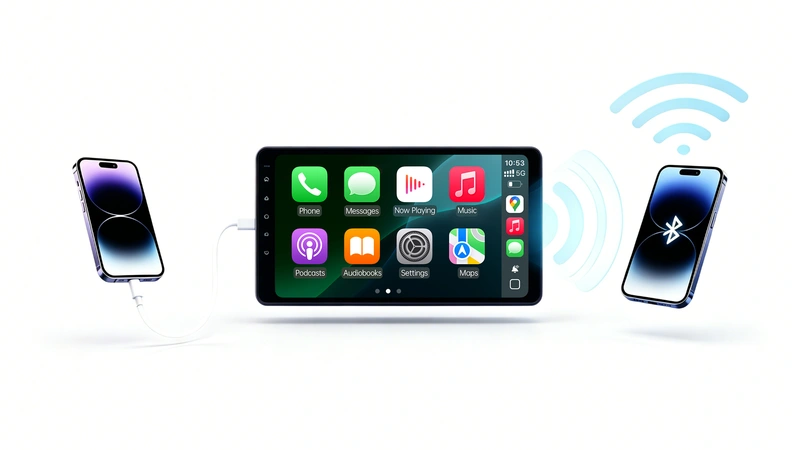
Wired CarPlay sends everything through a USB cable, so the data has a direct digital path between the phone and the car.
Wireless CarPlay uses two radios. Bluetooth sets up the initial connection, then Wi-Fi carries most of the data for navigation, music, calls and Siri. The video has to be encoded, sent over the air, received, decoded and displayed, which adds a little time compared with a cable.
Side by side
| Wired CarPlay | Wireless CarPlay | |
|---|---|---|
| Starting a drive | Plug in the cable each time | The phone connects on its own after a handshake that can take roughly 5 to 15 seconds |
| Responsiveness | Lowest latency | A small added delay, such as about 0.5 to 2 seconds when skipping tracks |
| Stability | Not affected by radio interference, but a worn cable or dirty USB port can cause drops | Can be affected by interference, heat and software issues |
| Audio quality | Bandwidth for the highest bitrates, preferred for lossless streaming | Fine for everyday streaming |
| Phone battery | Charges while connected | Uses more power because Wi-Fi runs constantly |
| Cable clutter | One cable in the cabin | None |
| Best for | Long drives, lossless audio, maximum reliability | Short trips, daily commuting, convenience |
Speed and lag
Any wireless link adds some delay, so wired CarPlay has the edge on raw responsiveness. In daily driving the gap is small when the wireless setup is well built. In daily driving the gap is small when the wireless setup is well built. It shows up mostly when you skip tracks, where a delay of about 0.5 to 2 seconds is generally expected. If lag is your main worry, our guide to wireless CarPlay lag explains what is normal and what is worth fixing.
Reliability
Neither connection is immune to problems. Wired CarPlay depends on the cable and the USB port, and a worn cable or lint in the port can cause intermittent drops. Wireless CarPlay depends on two radios, so dash cams, Bluetooth transmitters, heat and outdated software can each interrupt it. If your wireless connection keeps dropping, our guide to wireless CarPlay disconnects walks through the causes and fixes. A quick test is to try the same phone on both connections. If wired stays stable and wireless does not, the wireless link is the place to look.
Audio quality
If you stream lossless music from a service such as Tidal or Apple Music Lossless, wired CarPlay has the bandwidth to carry the highest bitrates, which is why it is the usual choice for listeners who care about every detail. For podcasts, navigation prompts, calls and regular streaming, For podcasts, navigation prompts, calls and regular streaming, wireless is generally fine.
Battery and charging
Wired CarPlay charges your phone while you use it. Wireless CarPlay does not, and because the phone transmits over Wi-Fi the whole time, it draws somewhat more power than a plain Bluetooth connection. On a short commute the difference is negligible. On a long road trip, plan to plug in or use a wireless charger.
Convenience
This is where wireless wins. You start the car, the phone joins automatically, and navigation or music resumes without the phone leaving your pocket. There is also no cable to plug in each time or wear out.
Which one should you choose?
Choose wireless if you make many short trips, like the phone to connect by itself and prefer a clean dashboard. Choose wired if you take long drives, want the phone charging the whole time, listen to lossless audio or drive somewhere with heavy wireless interference. If your setup supports both, you can use wireless day to day and keep a cable in the glove box for long trips. s
What about older Toyota and Lexus vehicles?
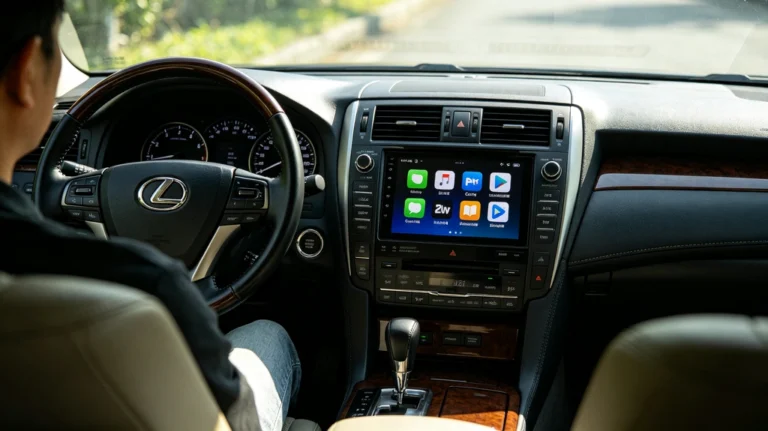
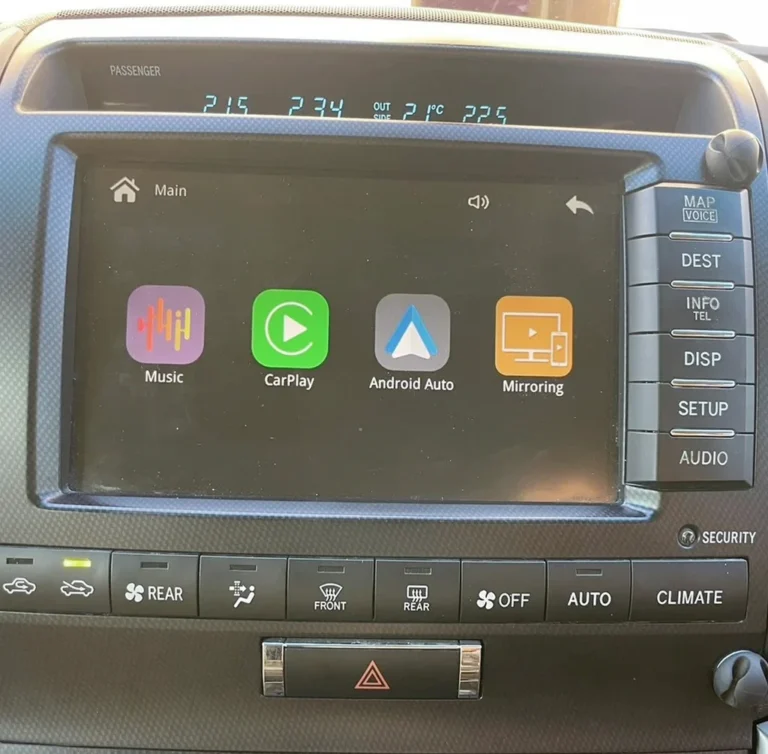
Many Toyota and Lexus models from roughly 2012 to 2020 shipped without CarPlay, so for their owners the real question is how to get CarPlay at all. An interface module adds CarPlay and Android Auto to the factory screen so you do not have to replace the head unit.
AUVETO modules connect to the factory head unit and keep the original screen, dashboard look and steering wheel controls. After installation, the phone pairs automatically over 5GHz Wi-Fi and Bluetooth when you start the engine. Kits ship with manuals and step-by-step video guides, and 1-on-1 remote tech support is included. If a wired fallback matters to you, ask the team about your specific model before you order.
Not sure your vehicle is compatible?
Toyota and Lexus screens vary by model, market and software version. Browse the AUVETO collection for your vehicle, or contact the team for a fitment check before you order.
FAQ
Is wireless CarPlay better than wired?
It depends on how you drive. Wireless is more convenient because it connects automatically. Wired has slightly lower latency, charges the phone and suits lossless audio, so it is better for long trips and critical listening.
Is wired CarPlay faster than wireless?
Yes, slightly. A cable removes the encoding, wireless transmission and decoding steps, so wired CarPlay has the lowest latency. With a well-built 5GHz wireless setup the difference is small in daily driving.
Does wireless CarPlay drain the phone battery?
A little more than wired. The phone keeps Wi-Fi active while connected and does not charge from the car. On short trips the effect is negligible, and on long drives you can plug in or use a wireless charger.
Is wireless CarPlay audio worse than wired?
For everyday streaming, calls and navigation prompts, wireless is generally fine. Wired has the bandwidth for the highest bitrates, so it is preferred for lossless audio.
Which is more reliable, wired or wireless CarPlay?
Wired avoids radio interference, so it is often more stable, but a worn cable or dirty USB port can still cause drops. Wireless can be affected by interference, heat and software, and most of those causes are fixable.
Can I add wireless CarPlay to an older Toyota or Lexus?
In many cases, yes. An interface module connects to the factory head unit and adds CarPlay and Android Auto to the original screen. Check compatibility for your model and year before ordering.